Submit News
 About us
 Advertise
 Contact us


 Aug 05, 2026
  4 min read
 Horse racing and tapeball cricket unite in new Guya...
In a landmark convergence of Guyana’s most passionate sporting cultures, horse racing and grassroots cricket have officially joined forces. The organisers of...


08 Aug 2026

In a landmark convergence of Guyana’s most passionate sporting cultures, horse racing and grassroots cricket have officially joined forces. The organisers of...

Any state initiative in the bottled water sector should be structured to strengthen, not compete with or undermine, existing private investment, the...

The family of two-year-old Larissa, who was diagnosed with West syndrome at two months old and experiences up to 100 seizures...

 The Festival of Colours explained


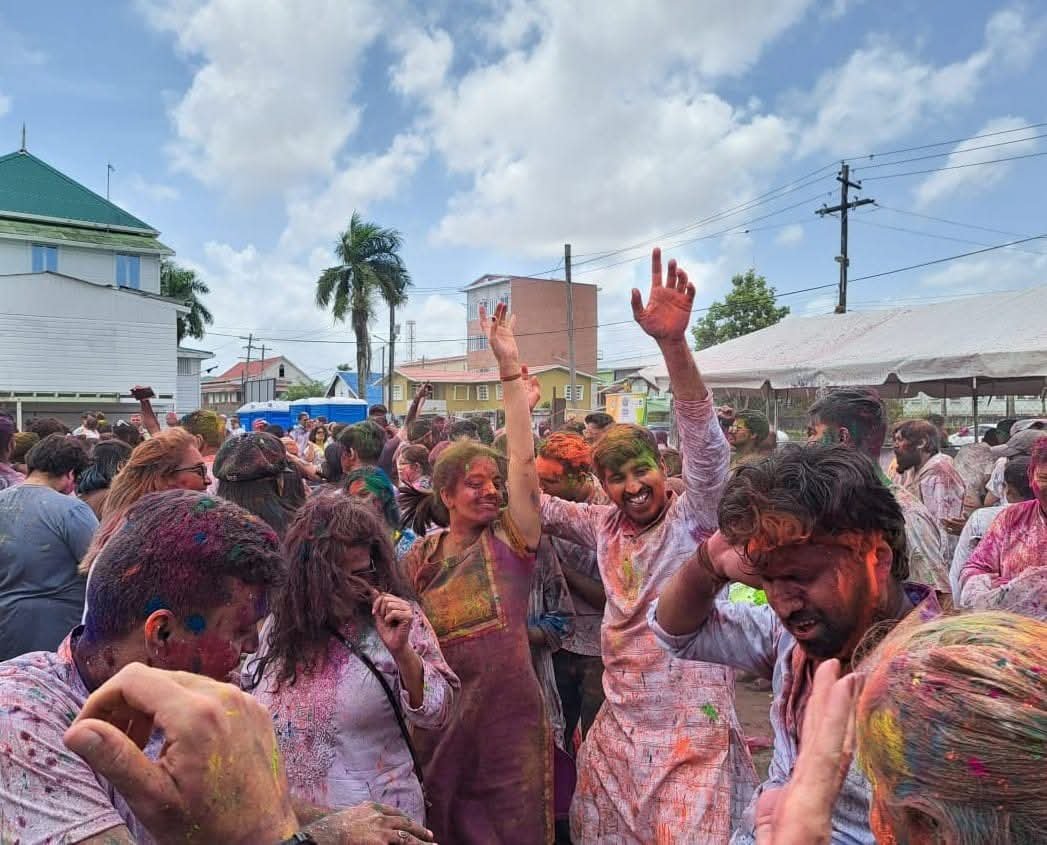
Holi, commonly known as Phagwah, is a widely celebrated festival that encapsulates happiness, togetherness, and the victory of good over evil.
For some, it marks the beginning of the Hindu New Year, while for others, it signifies the arrival of spring—a fresh start and a season of forgiveness. The festival usually falls in late February or March.
There are several legends associated with the significance of this day and the way it is celebrated. These stories vary depending on where in the world the festival is observed.
However, the most common legend is the story of young Prahlad and his evil aunt Holika, which signifies the triumph of good over evil.
The story of young Prahlad tells of a demon king who won control over the Kingdom of Earth through years of prayer and meditation to Lord Brahma. However, once his desires were fulfilled, he decided to use his blessings for evil.
He was the king of the demonic Asuras, and according to the Bhagavata Purana, he was granted a boon, or wish, that he could not be killed by a human being or an animal, neither indoors nor outdoors, neither during the day nor at night, neither by astra (projectile weapons) nor shastra (handheld weapons), and neither on land, in water, nor in the air. This effectively made him immortal.
After receiving his boon, the king became so egotistical that he commanded everyone in his kingdom to worship only him. However, to his great disappointment, his son, Prahlad—a devotee of Lord Vishnu, the sustainer of the universe—refused to worship his father. In response, the king made several attempts to kill his son, but Lord Vishnu saved him every time.
Growing frustrated, the king asked his sister, Holika, to enter a blazing fire with Prahlad on her lap, as she had a blessing that made her immune to fire.
Holika agreed and tricked young Prahlad into sitting on her lap before taking her seat in the fire. However, as good always triumphs over evil, Holika was unaware that her boon only worked when she entered the fire alone. As a result, she was burned to ashes.
Prahlad, who continued chanting the name of Lord Vishnu, emerged unscathed. This is why the festival is associated with the victory of good over evil.
The story of Prahlad also highlights why Lord Vishnu is connected to Holi and should be worshipped on this day.
Although Holika was destroyed in the fire, the evil king remained alive. Due to his boon, Lord Vishnu took his fourth avatar and came to Earth as Lord Narasiṃha—a form that was part-lion, part-man—to slay him and restore dharma (righteousness).
Holi is also known as the festival of love, as it celebrates the eternal and divine love of Shree Radha Krishna.
Krishna joyfully coloured Radha Rani with an array of colours and lovingly teased her during the Holi celebrations. Their story is one of the world’s most famous love stories—a love that is selfless and transcends the physical and even the soul.
Their love story is linked to Krishna’s love for Radha. According to the scriptures, Krishna’s skin was dark because a demoness had tried to poison him when he was a baby. Because of this, Krishna worried that Radha Rani would not like him.
His mother, Mata Yashoda, playfully suggested that he smear brightly coloured powder on Radha’s face.
After Shri Krishna did this, Radha fell in love with him. This teaches us that love sees no colour—regardless of our appearance, we are all equal and should be treated as such.
Holi also celebrates the farmers’ spring harvest in many parts of the world.
People sing, dance, and celebrate with bright colours and powders, welcoming the spring season and the rewards of their crops with great fanfare.
In Guyana, the festival not only marks all of the above but has also become a celebration of unity among our people and country. It brings us together through large celebrations in communities across the nation.
People spend the day preparing a variety of Indian sweetmeats and food, visiting family and friends, and spreading love and joy.
Smearing coloured powder (abeer, abrak) and playfully soaking one another in water is an integral part of the festivities, making Holi a truly vibrant celebration.
The celebrations begin locally with the planting of Holika on Vasant Panchami, followed by the periodic singing of chowtal in anticipation of the festival.
This unique style of music typically features two rows of singers facing each other in a semi-circle, accompanied by a dholak drummer at one end. They sing lines of Bhojpuri text with varying rhythms.
This musical tradition was brought to Guyana during indentureship in the 1800s and remains deeply rooted in our culture.
On the night before Holi is celebrated, Holika Dahan takes place, during which the Holika planted on Vasant Panchami is burned.
On the morning of Phagwah, individuals begin the celebrations by rubbing the ash from the burned Holika onto each other, signifying the belief that “from ash we come, and to ash we must return.”
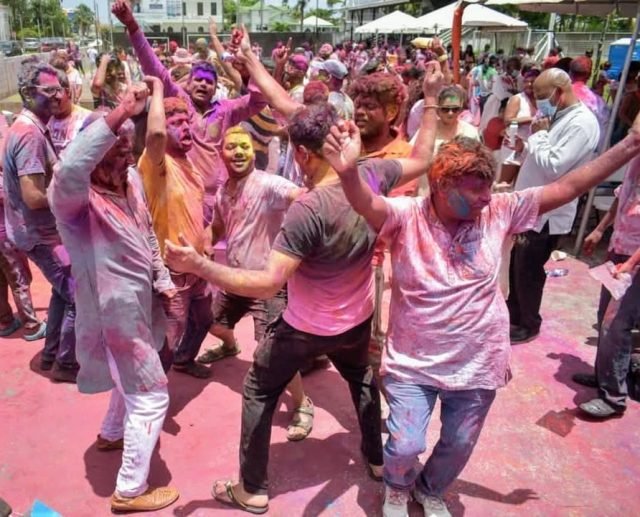
To all who are celebrating today, we wish you a happy and prosperous Holi!
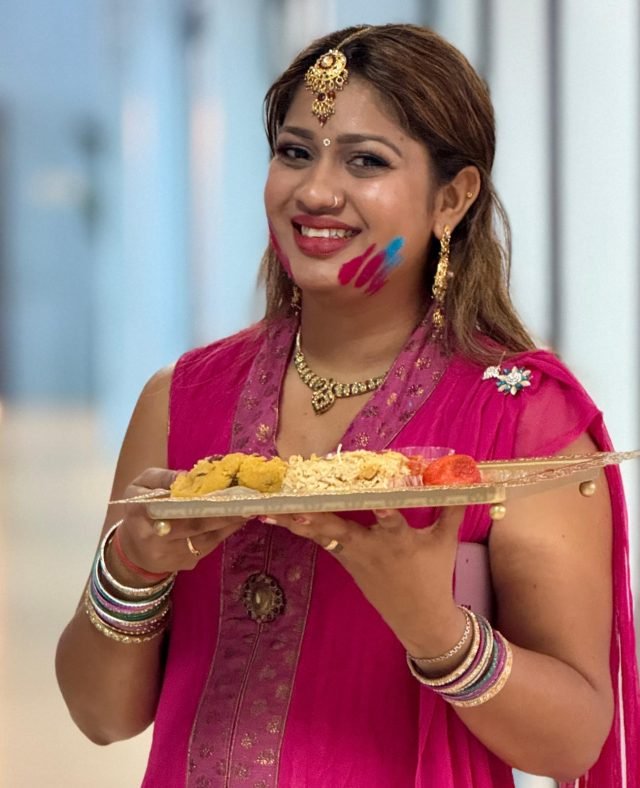
Shivanie Rampersaud