Submit News
 About us
 Advertise
 Contact us


 Aug 05, 2026
  4 min read
 Horse racing and tapeball cricket unite in new Guya...
In a landmark convergence of Guyana’s most passionate sporting cultures, horse racing and grassroots cricket have officially joined forces. The organisers of...


08 Aug 2026

In a landmark convergence of Guyana’s most passionate sporting cultures, horse racing and grassroots cricket have officially joined forces. The organisers of...

Any state initiative in the bottled water sector should be structured to strengthen, not compete with or undermine, existing private investment, the...

The family of two-year-old Larissa, who was diagnosed with West syndrome at two months old and experiences up to 100 seizures...

 How easter has evolved in Guyana


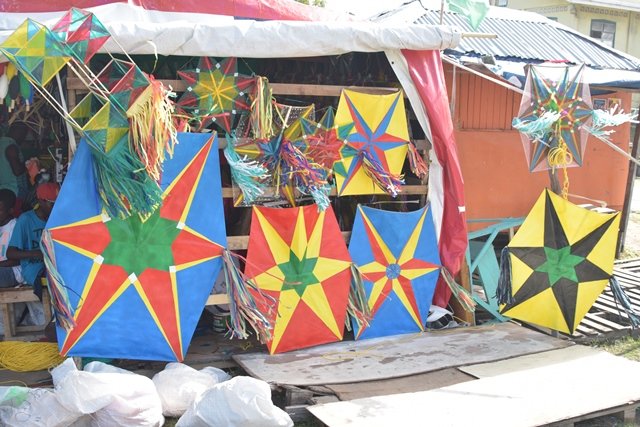
In Guyana, Easter is a celebration that touches the ground with reverence and soars into the sky with joy. It’s a time when the nation pauses to reflect and rejoice, and when streets, sea walls, and open fields become filled with colour, laughter, and the unmistakable hum of kites singing through the air.
But Easter in Guyana wasn’t always what it is today. Like the kites themselves, it has taken flight—shaped by history, lifted by tradition, and guided by the winds of change.
Decades ago, Easter in this South American nation had a more solemn tone. “It used to be all about the church,” recalls 86-year-old Miss Racheal Lowell. “Good Friday was a quiet day. No meat, no music, no nonsense. We would walk to church in silence, sometimes barefoot, just to feel the sacrifice. Easter Sunday was joy, but it was still sacred. You dressed nice and gave thanks. Kites? That came later.”
The tradition of kite flying at Easter in Guyana is now iconic, but its origins are somewhat hazy. Some say it began as a symbolic act representing the resurrection and ascension of Christ. Others believe it was more of a colonial import, borrowed and then reborn in Guyanese hands. What is certain is that by the mid-20th century, Easter Monday was no longer just the day after church—it was the day.
Kites became a cultural fixture, and the art of building them transformed into a treasured ritual, especially among boys eager to prove their skill with the biggest, baddest kite on the block.
Seventeen-year-old Marcus James knows that feeling well. “I been building kites since I was a lil boy with my uncle. He used to show me how to split bamboo with a razor blade. We used to go bush for the wood, dry it, shave it, and bend it with thread and glue. That’s how you make a proper ‘Kaddy old punch.’” He said.
“Now plenty people just buy theirs in town or from Chinese shores, but some of us still keep it real. Kite building teach you patience, style, and how to lose and not vex when your kite crash,” he shared.
For Guyanese people, Easter Monday has become a national reunion of sorts.
Churches still overflow on Easter Sunday with faithful worshippers, but Monday belongs to everyone. Christians, Hindus, Muslims, and people of all beliefs gather side by side on the sea wall and in wide fields, sharing picnic food, tossing footballs, and battling the skies with homemade and store-bought kites alike.
Though times have change the bambo frames now rivalled by plastic ones, the tails longer, the kites sometimes embedded with lights and sound chip the spirit remains untouched. It is a spirit born of resilience, creativity, and unity.
In a land where stories are passed down through generations like heirlooms, the story of Easter is one of evolution. From whispered prayers to roaring winds, from solemn pews to crowded picnic blankets, from plain brown paper to shimmering foil wings dancing under the sun.
Easter in Guyana is a time when heaven feels just a little closer, tethered to earth by string and soul. And every time a kite lifts off the ground, it carries not just joy, but memory, and the hopes of a people who know how to rise.
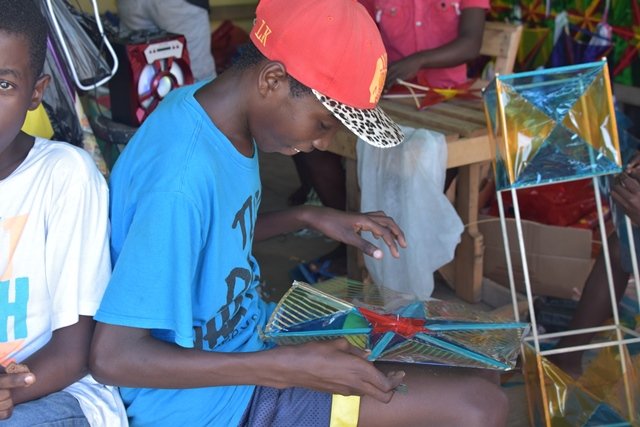 A boy applies the finishing touches on his kite
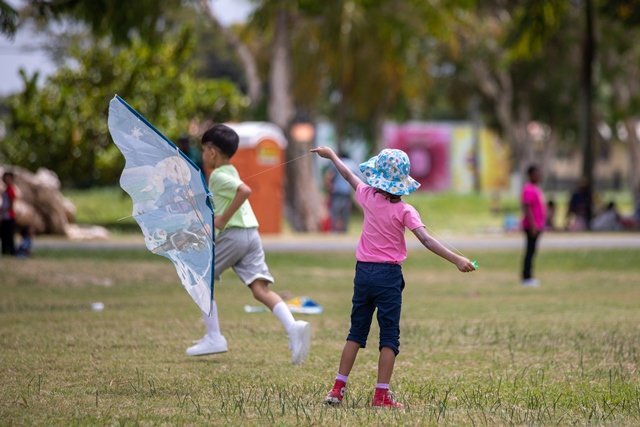
Children enjoying Easter in the National Park
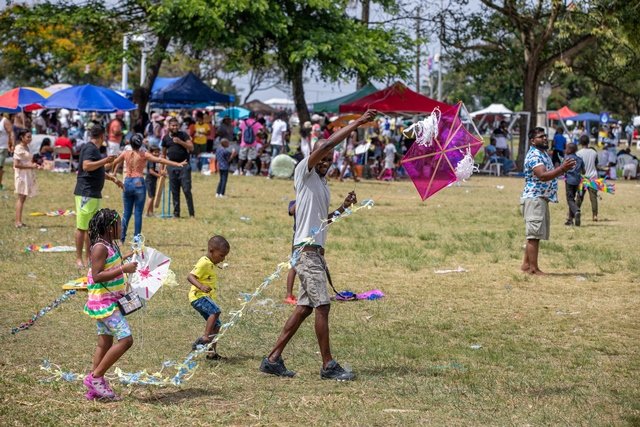
A father in all smiles with his children at the National Park