Submit News
 About us
 Advertise
 Contact us


 Aug 05, 2026
  4 min read
 Horse racing and tapeball cricket unite in new Guya...
In a landmark convergence of Guyana’s most passionate sporting cultures, horse racing and grassroots cricket have officially joined forces. The organisers of...


09 Aug 2026

In a landmark convergence of Guyana’s most passionate sporting cultures, horse racing and grassroots cricket have officially joined forces. The organisers of...

Any state initiative in the bottled water sector should be structured to strengthen, not compete with or undermine, existing private investment, the...

The family of two-year-old Larissa, who was diagnosed with West syndrome at two months old and experiences up to 100 seizures...

 Journalists urged to prioritise truth over trend


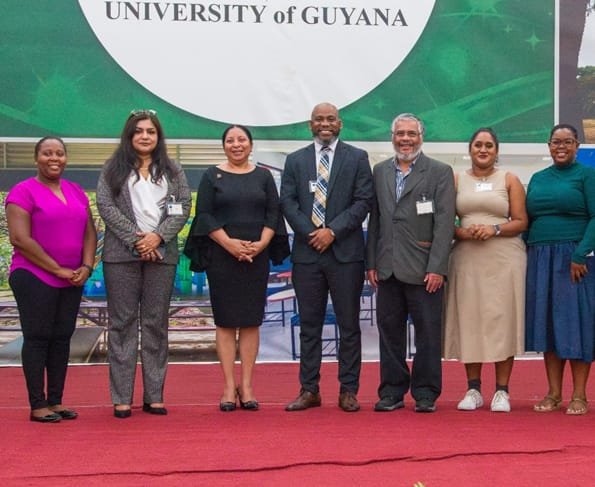
“Truth should be emphasised over trends; news media is not social media.” That was the powerful message delivered by international media strategist Juan Señor as he addressed the opening of the 2025 Caribbean Media Summit on Friday, at the University of Guyana’s George Walcott Lecture Theatre (GWLT), Turkeyen Campus.
Señor, delivering the keynote address, emphasised the urgent need for a “Hum-AI-ne” approach to journalism. He argued that while artificial intelligence can support content production, it must not replace the journalist’s central role in truth-telling. He reminded attendees that human oversight remains fundamental to journalism, which must continue to prioritise accuracy, integrity, and a deep commitment to public service.
According to a release from the summit, he cautioned journalists against chasing speed at the expense of insight and urged them to reclaim their role as information gatekeepers in an oversaturated digital landscape. “Real journalism is slow, deliberate, and essential,” he stated, underscoring the need for verification before amplification.
Señor explained that newsrooms must act as filters and focus on what he termed “the scarcity”—the ability of journalists to go deeper in order to reach wider audiences. He encouraged bundling journalism in innovative formats and targeting specific professional communities as ways to drive subscription revenue and content engagement.
With the global demand for quality journalism rising, Señor reminded participants: “Journalism is about truth or nothing, and the truth needs editors such as journalists.” He closed by reaffirming the unique identity of journalism, apart from social media and influencer-driven content: “News must be what it always was: truth and facts. Media must monetise ethically—through subscriptions, partnerships with streaming platforms, and more—without losing its essence.”
The two-day summit, held under the theme “Evolving Media Business in Turbulent Times – AI, Journalism and the Future,” brought together media practitioners, academics, policymakers, and digital innovators from across the Caribbean to address the rapidly shifting media landscape. The event was coordinated by the Media Institute of the Caribbean (MIC) in collaboration with the University of Guyana (UG) and the Guyana Press Association (GPA).
Participants engaged in discussions on media sustainability, AI integration, public trust, new business models, and journalistic integrity—key issues as regional media face declining revenues, technological disruption, and changing audience behaviours.
Professor Paloma Mohamed Martin, Vice-Chancellor of the University of Guyana, urged the region’s media to confront the realities of a digitally saturated world. “Given the ubiquity of social media and the real-time dissemination of all forms of information, traditional news outlets must either leverage their unique strengths or undergo radical transformation to remain viable and relevant. The industry must explore new models to bring developing stories to the forefront swiftly. This may mean the creation of a new form of inter-organisational syndication. Journalistic investigation must now incorporate the myriad streams of information supplied by emerging technologies, which are sometimes employed in informal contexts.”
She added that media organisations must use their unique positioning to engage new technologies meaningfully. “They must become deeply engaged in mastering new technologies and learn to manipulate and deploy these tools to gather, parse, produce, and disseminate media content responsibly, accurately, widely, and with collective fidelity to efficiency, speed, and present realities.”
According to Professor Mohamed, the new media ecosystem requires journalists to deliver content that is “Quick, Understandable, Ubiquitous, and Comprehensive—QUUC,” adding that “only those who strike this balance will thrive in the future media ecosystem.”
MIC President Kiran Maharaj also addressed the gathering, warning that the region’s media industry stands at a critical juncture. “The Caribbean media landscape stands at a crossroads. Between 15 to 25 per cent of our advertising revenue is diverted to global tech platforms. We must advocate for equitable AI governance and explore new revenue models that blend innovation with ethical responsibility.”
She added: “This summit is a call to action. We must advocate for equitable AI governance that prioritises public interest journalism and explore new revenue models that blend innovation with ethical responsibility. Collaboration is essential. We must persevere to serve the public good, even in the most turbulent times.”
GPA President Nazima Raghubir underscored the relevance of the summit in addressing the survival of independent journalism. “With traditional revenue streams in decline, innovation must walk hand-in-hand with journalistic ethics. This summit is an opportunity to shape resilient, regionally relevant strategies,” she said.
The 2025 Caribbean Media Summit represents a unified call for regional collaboration, ethical innovation, and renewed investment in journalism. Organisers hope the forum will inspire actionable strategies to protect press freedom, empower Caribbean storytelling, and create a financially viable, future-ready media industry.
The event was supported by ExxonMobil, Caribbean Airlines, and the United Nations Guyana.