Submit News
 About us
 Advertise
 Contact us


 Aug 05, 2026
  4 min read
 Horse racing and tapeball cricket unite in new Guya...
In a landmark convergence of Guyana’s most passionate sporting cultures, horse racing and grassroots cricket have officially joined forces. The organisers of...


09 Aug 2026

In a landmark convergence of Guyana’s most passionate sporting cultures, horse racing and grassroots cricket have officially joined forces. The organisers of...

Any state initiative in the bottled water sector should be structured to strengthen, not compete with or undermine, existing private investment, the...

The family of two-year-old Larissa, who was diagnosed with West syndrome at two months old and experiences up to 100 seizures...

 Region 10 Students Included in $640M Education Grant Rollout


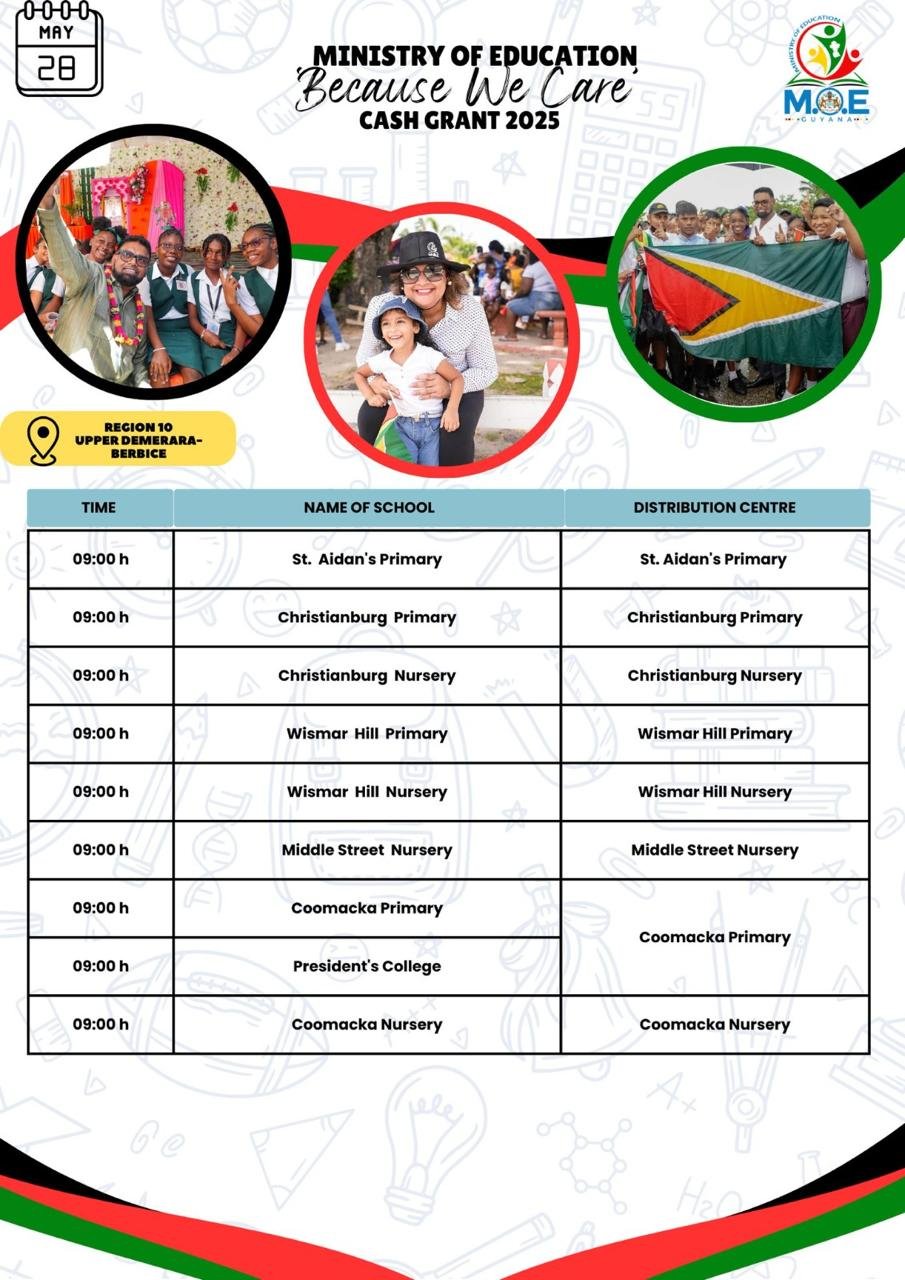
As part of the government’s ongoing effort to ensure equitable education for all Guyanese children, the nationwide cash grant programme has now expanded to Region 10 (Upper Demerara-Berbice), marking a major milestone in the phased distribution that began earlier this month.
Education Minister Priya Manickchand confirmed the expansion in a message posted on her official Facebook page, stating that by the end of this week, over $640 million will have been disbursed to families across the country. She emphasized that the initiative is not only financial relief but also a demonstration of the government’s commitment to inclusive education—ensuring no child is left behind due to geography or economic status.
Launched on May 12, 2025, in the hinterland Regions Seven (Cuyuni-Mazaruni), Eight (Potaro-Siparuni), and Nine (Upper Takutu-Upper Essequibo), the distribution rollout has been staggered to maximize efficiency and coverage. Now entering Region 10, the programme is set to benefit thousands more students in one of the country’s most populous areas.
Under the initiative, each eligible child receives $55,000—comprising a $50,000 cash grant and a $5,000 school uniform voucher. This represents a significant increase from 2021, when the total was just $19,000. The nearly threefold rise highlights the government’s intensified investment in human capital and its broader agenda to transform Guyana’s education system.
“This programme is about more than money—it’s about fairness, access, and giving every child the tools they need to succeed,” Minister Manickchand has said at several public engagements.
Unlike many state-funded initiatives that target only public schools, this grant includes both public and private school students, reflecting a comprehensive approach to national educational development. In 2025 alone, more than 205,000 students are expected to benefit from the programme, backed by an $11 billion allocation in the national budget.
Parents in Region 10 have expressed optimism and gratitude, viewing the grant as timely support amid rising living costs. For many families, the assistance means the difference between sending their children to school fully equipped or facing financial struggles to cover basic educational needs.
The expansion into Region 10 signals more than just the continuation of a programme—it underscores the government’s stance that education is a right, not a privilege, and that every child, regardless of location, deserves an equal chance to succeed.