Submit News
 About us
 Advertise
 Contact us


 Aug 05, 2026
  4 min read
 Horse racing and tapeball cricket unite in new Guya...
In a landmark convergence of Guyana’s most passionate sporting cultures, horse racing and grassroots cricket have officially joined forces. The organisers of...


08 Aug 2026

In a landmark convergence of Guyana’s most passionate sporting cultures, horse racing and grassroots cricket have officially joined forces. The organisers of...

Any state initiative in the bottled water sector should be structured to strengthen, not compete with or undermine, existing private investment, the...

The family of two-year-old Larissa, who was diagnosed with West syndrome at two months old and experiences up to 100 seizures...

 Lending to micro, small and medium-sized enterprises tripled in past five years


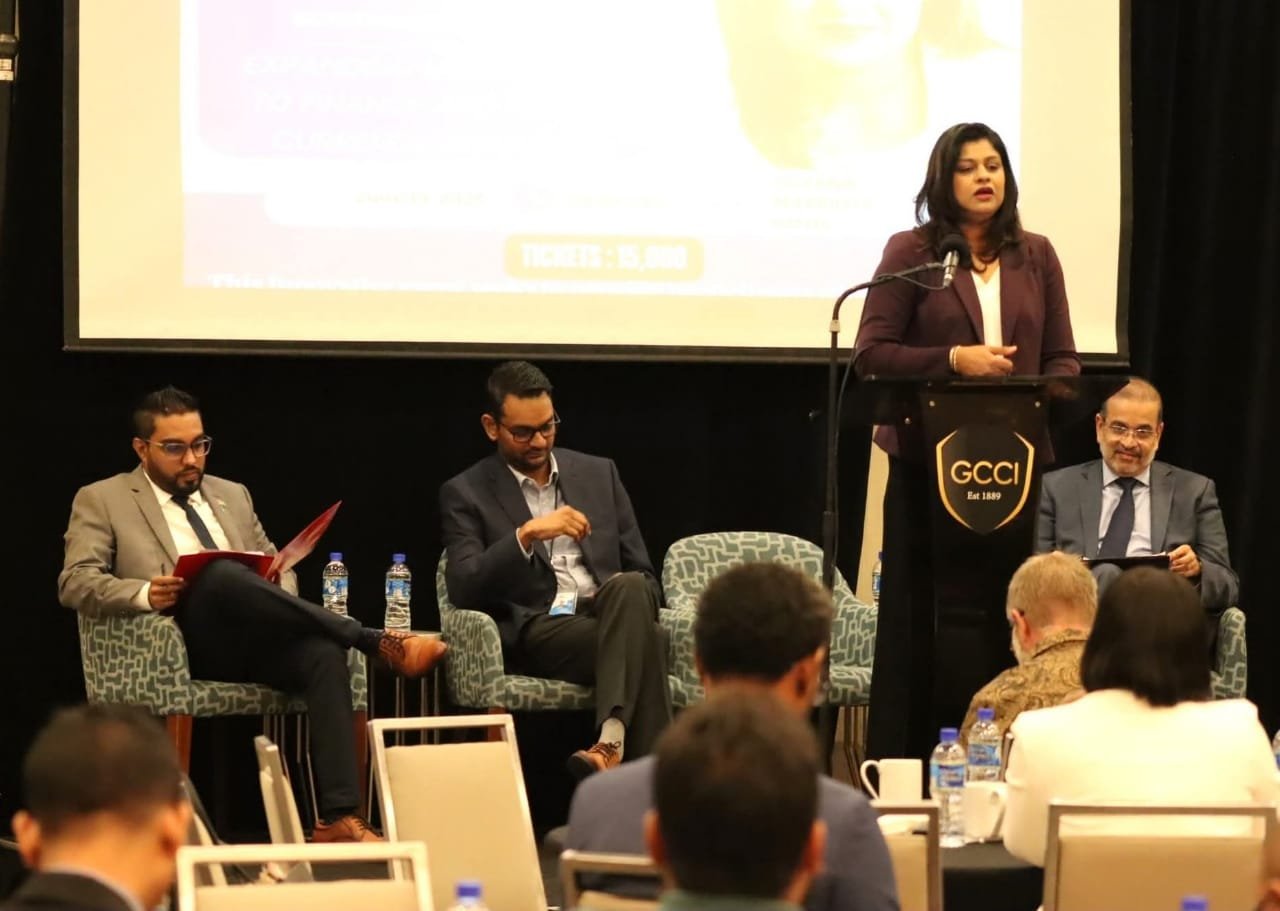
Lending to micro, small and medium-sized enterprises (MSMEs) in Guyana has more than tripled over the past five years, according to financial sector leaders, as more than 120 entrepreneurs gathered to explore financing strategies in the country’s evolving economy.
The insight was shared during the third edition of the Georgetown Chamber of Commerce and Industry’s (GCCI) Business Breakfast Seminar, held Thursday at the Guyana Marriott Hotel with support from the Guyana Bank for Trade and Industry (GBTI).
Chair of the Guyana Association of Bankers Inc. (GABI), Nafeeza Gaffoor, said the banking sector remains committed to enabling MSME growth in the current economic boom.
“We are gathered at a time of remarkable opportunity. Guyana’s economy is growing at a pace rarely seen globally. Yet, amidst this expansion, we must ensure that no segment is left behind, especially our Micro, Small and Medium-sized Enterprises,” she said.
Gaffoor pushed back against the view that banks are overly cautious. “There is a persistent view that banks are risk averse, hesitant, and perhaps overly conservative. I would like to say instead that banks are risk-conscious and we are risk managers,” she said, while noting the uptick in MSME lending.
She said lending decisions hinge on multiple variables such as capacity, character, collateral, capital and compliance. “When one or more of these are missing, it does not mean necessarily mean that the business is not profitable, it simply means we need to work together to strengthen the credit proposal,” she added.
Commenting on foreign exchange concerns, Gaffoor stated, “Foreign exchange is earned, not printed… Banks are streamlining and digitising foreign exchange requests, prioritising productive sectors, and collaborating with the Bank of Guyana on frequent allocations.”
GCCI President Kathy Smith described the seminar as a move to “ensure that businesses are equipped with the knowledge and resources needed to propel their operations”.
“Guyana is growing. Last year, over US$743 million was spent on local content utilisation—that is contracts, employment, and capacity building for Guyanese businesses and employees. We now have 1,100 companies registered on the Local Content Register and the GCCI wants to see all its members at the forefront of these opportunities,” she said.
Smith acknowledged existing financing hurdles faced by entrepreneurs. “I have noticed that some businesses are still doing business in an informal way, and this conduct is altering the confidence the bank has in you,” she said.
She also welcomed recent government reforms such as the Security Interest in Moveable Property Act, which she said has been a “game-changer for the private sector”.
Executive Director of NewHayven Merchant Bank, Kurt Kisto, encouraged businesses to consider alternative financing channels. “Why does alternative financing matter? Because access to capital should not be limited to a select few, because innovation and entrepreneurship should not be stifled by outdated financing models, and because businesses today need funding models that are agile, customised, and entrepreneurship-friendly,” he said.
He listed options including private equity, venture capital, angel investing, crowdfunding and blockchain-based financing mechanisms.
GBTI Chief Executive Officer Shawn Gurcharran presented the bank’s GROW Programme, designed to support MSMEs with loans up to $30 million, alongside competitive rates and advisory services.
“When we envisioned GROW, we thought that it was needed in a rapidly growing economy,” he said. “We really do believe that those enterprises that may be small today… will grow and become significant in the economy that we operate.”
He also discussed GBTI’s Invoice Financing product aimed at suppliers in the oil and gas industry. “With GBTI’s Invoice Financing, you need to be registered and be a validated supplier for one of the large oil and gas companies. The terms are flexible and there are no hidden fees,” he said.
The GCCI said the seminar was intended to strengthen the entrepreneurial ecosystem as Guyana’s economy expands. According to official data, credit to the private sector rose from $376 billion in 2023 to $450.6 billion in 2024.
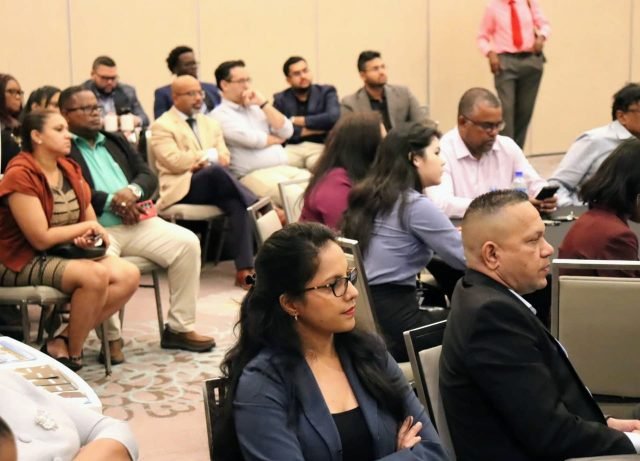
A section of the gathering at the forum (GCCI photo)
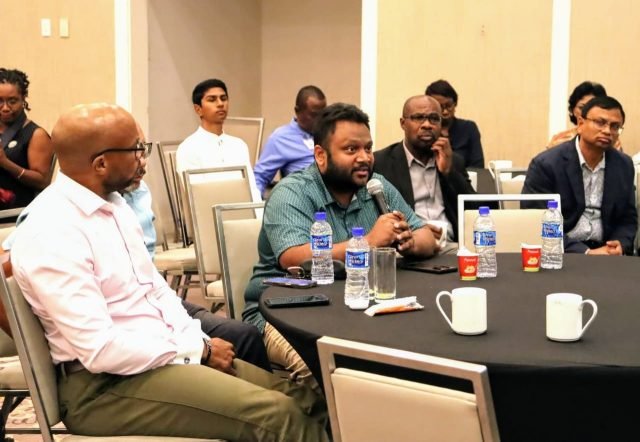
A participant raises a question (GCCI photo)