Submit News
 About us
 Advertise
 Contact us


 Aug 05, 2026
  4 min read
 Horse racing and tapeball cricket unite in new Guya...
In a landmark convergence of Guyana’s most passionate sporting cultures, horse racing and grassroots cricket have officially joined forces. The organisers of...


10 Aug 2026

In a landmark convergence of Guyana’s most passionate sporting cultures, horse racing and grassroots cricket have officially joined forces. The organisers of...

Any state initiative in the bottled water sector should be structured to strengthen, not compete with or undermine, existing private investment, the...

The family of two-year-old Larissa, who was diagnosed with West syndrome at two months old and experiences up to 100 seizures...

 Nomination Day: Key details you should know


Today is Nomination Day in Guyana, the day political parties officially submit their lists of candidates for the upcoming General and Regional Elections, scheduled for September 1.
The Guyana Elections Commission (GECOM) has confirmed that 21 political parties are eligible to submit candidate lists to be included on the national ballot. But getting on the ballot is no simple task. Guyana’s electoral rules require strict adherence to guidelines that ensure fairness, regional representation, and gender equality.
List-Based Voting, Not Individual Candidates
Guyanese voters do not vote for individual candidates. Instead, they choose a party list, and seats in the 65-member National Assembly and on the 10 Regional Democratic Councils (RDCs) are allocated based on how many votes each party receives via a system of Proportional Representation. This ensures that the composition of Parliament and the RDCs reflects the percentage of votes each party earns, with added rules to promote geographical and gender balance.
General Elections
There are two sperate elections being held on September 1. The General election decides who sits in parliament and by extension which party governs the country.
To make it on to the ballot each party must submit two types of lists: a National Top-Up List and Geographical Constituency Lists
The National Top-up list accounts for 40 of the 65 National Assembly seats and must include at least 42 candidates, of whom one-third must be women. It is this list that identifies the party’s Presidential Candidate.
Notably this list must be backed by 300 to 330 nominators.
Geographical Constituency Lists
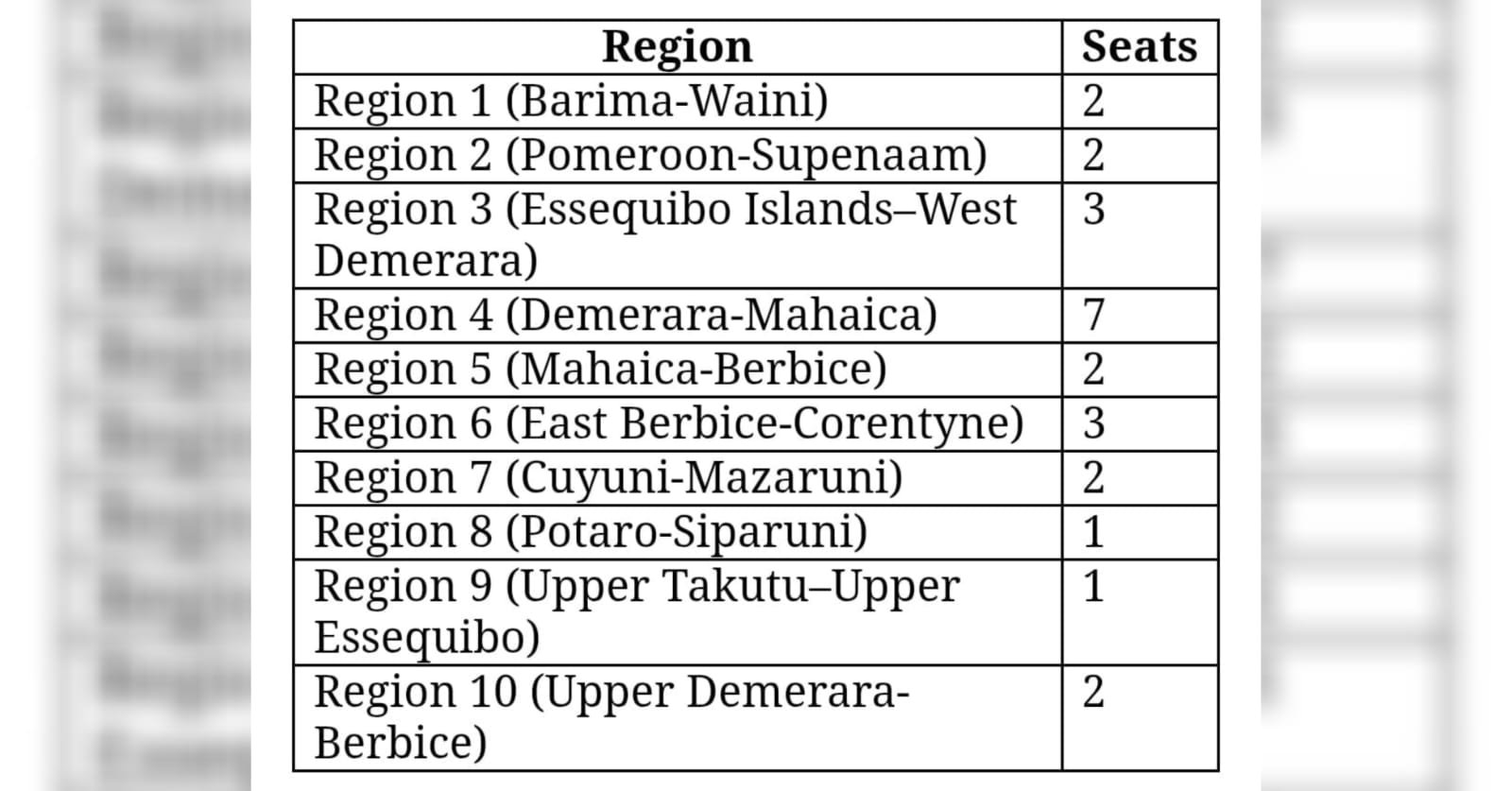
The remaining 25 seats are distributed across the country’s 10 administrative regions as follows:
Region
Seats
Region 1 (Barima-Waini)
2
Region 2 (Pomeroon-Supenaam)
2
Region 3 (Essequibo Islands–West Demerara)
3
Region 4 (Demerara-Mahaica)
7
Region 5 (Mahaica-Berbice)
2
Region 6 (East Berbice-Corentyne)
3
Region 7 (Cuyuni-Mazaruni)
2
Region 8 (Potaro-Siparuni)
1
Region 9 (Upper Takutu–Upper Essequibo)
1
Region 10 (Upper Demerara-Berbice)
2
To be eligible to contest the general elections, a party must submit constituency lists in at least six regions, covering a minimum of 13 seats. A game of mix and match could see a party submitting geographical constituency lists for the more accessible regions of Two, Three, Four, Five, Six and 10 for a total of 19 seats.
Each geographical constituency list must include enough candidates to fill the seats in that region, plus two additional names and be supported by 150 to 175 nominators
A candidate may appear on only one geographical constituency list, but can also appear on the National Top-Up List. They may sign as nominators for the list on which they appear.
Gender Representation is Mandatory
Gender equality is legally mandated: every party must ensure that at least one-third of their candidates, on national top up list and on the sum total of geographical constituency lists, are female. GECOM enforces this provision strictly during the nomination process.
Regional Elections
Regional Elections are a bit more straight forward. To contest regional elections, a party must submit a List of Candidates for each regional ballot on which it wishes to appear.
Only voters residing in a region and registered as electors can vote for their RDC representatives. Likewise, each regional list must be supported by 150 to 175 nominators, who must also live in that region and be registered voters.
These lists determine who will serve on the RDCs, which manage local governance matters such as infrastructure, health, and education services within each region. Like the national lists, they are subject to GECOM approval and gender requirements.
Nomination Day is a critical milestone in the election process. It is the moment parties officially enter the race, demonstrating they have qualified candidates and public support.
For voters, it signals the official start of campaign season. Once GECOM approves the lists, the stage is set for rallies, debates, and the final push to Election Day.
As of today, all 21 political parties have the opportunity to submit their lists. Once accepted, those lists will determine who gets the chance to represent the people of Guyana for the next five years.