Submit News
 About us
 Advertise
 Contact us


 Aug 05, 2026
  4 min read
 Horse racing and tapeball cricket unite in new Guya...
In a landmark convergence of Guyana’s most passionate sporting cultures, horse racing and grassroots cricket have officially joined forces. The organisers of...


11 Aug 2026

In a landmark convergence of Guyana’s most passionate sporting cultures, horse racing and grassroots cricket have officially joined forces. The organisers of...

Any state initiative in the bottled water sector should be structured to strengthen, not compete with or undermine, existing private investment, the...

The family of two-year-old Larissa, who was diagnosed with West syndrome at two months old and experiences up to 100 seizures...

 Fire service weary of prank calls, false alarms and stubborn motorists


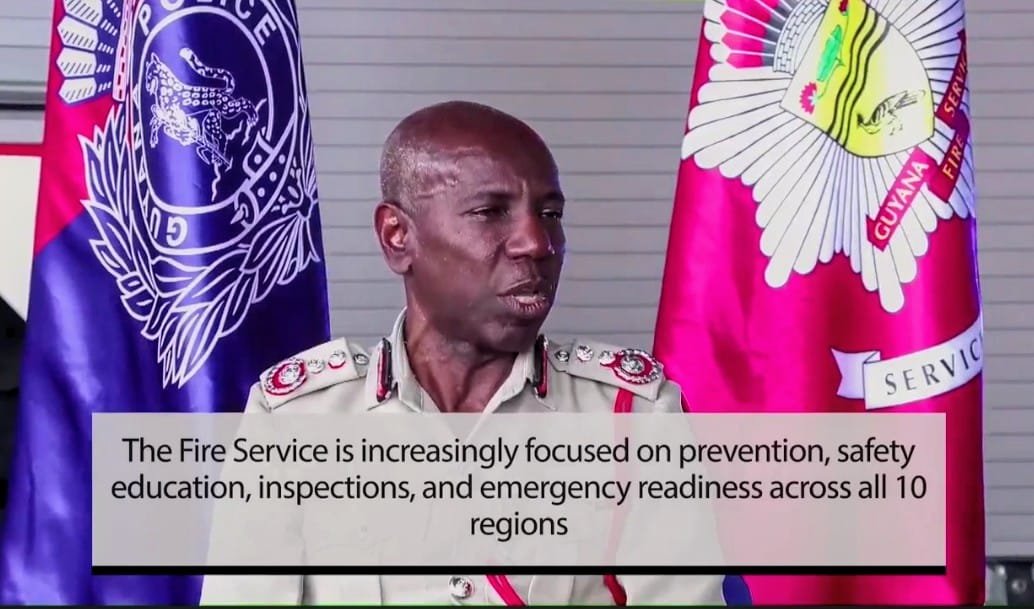
Chief Fire Officer Gregory Wickham has issued a stark appeal to the public to act responsibly during emergencies.Speaking on Episode 8 of the programme Safeguarding Our Nation, he warned that lives are being put at risk by prank calls, false alarms, and motorists who refuse to yield to fire trucks.
Wickham said there has been an alarmingly large increase in prank calls to the Guyana Fire Service (GFS) in recent times.“For those persons who’ve been in the habit of making prank calls to the fire service, my advice to you is that you first of all consider the waste of resources that it takes to go to a call when there is eventually need for those appliances to be there. Think of your parent, your friend, your child. Their life could depend on that siren,” he said.
The episode also addressed persistent myths, such as claims that fire trucks respond without water.
Wickham clarified that every tender carries 450 gallons and that firefighters are trained to access other water sources when needed.
“All fire tenders do have water in them. We always turn up, and we always have our tanks supply ready to respond,” he said.
Wickham noted that over 4,000 emergency medical calls were answered by the GFS this year, and five babies were successfully delivered by Emergency Medical Technicians (EMTs).
He said over $9 billion has been invested in new fire tenders, pickups, and fire stations, with an expansion from five stations in the 1990s to 22 today, with six more under construction.
Additionally, there has been increased emphasis on prevention through school inspections, public drills, and national safety campaigns.
Wickham noted, however, that public behaviour remains one of the service’s biggest challenges, as two-thirds of emergency calls are hoaxes or false reports, vehicles blocking fire trucks cause dangerous delays, and false alarms at schools have diverted resources from genuine emergencies.
“We’ve invested, expanded, and trained,” Wickham said. “But none of it matters if the public fails to act responsibly.”
The programme spotlighted the transformation of the Guyana Fire Service (GFS) into a modern, multi-faceted emergency response agency.
Once primarily focused on firefighting, the GFS now plays a critical role in medical response and public safety education.