Submit News
 About us
 Advertise
 Contact us


 Aug 05, 2026
  4 min read
 Horse racing and tapeball cricket unite in new Guya...
In a landmark convergence of Guyana’s most passionate sporting cultures, horse racing and grassroots cricket have officially joined forces. The organisers of...


11 Aug 2026

In a landmark convergence of Guyana’s most passionate sporting cultures, horse racing and grassroots cricket have officially joined forces. The organisers of...

Any state initiative in the bottled water sector should be structured to strengthen, not compete with or undermine, existing private investment, the...

The family of two-year-old Larissa, who was diagnosed with West syndrome at two months old and experiences up to 100 seizures...

 Caribbean Week of Agriculture 2025 Kicks Off in St. Kitts and Nevis


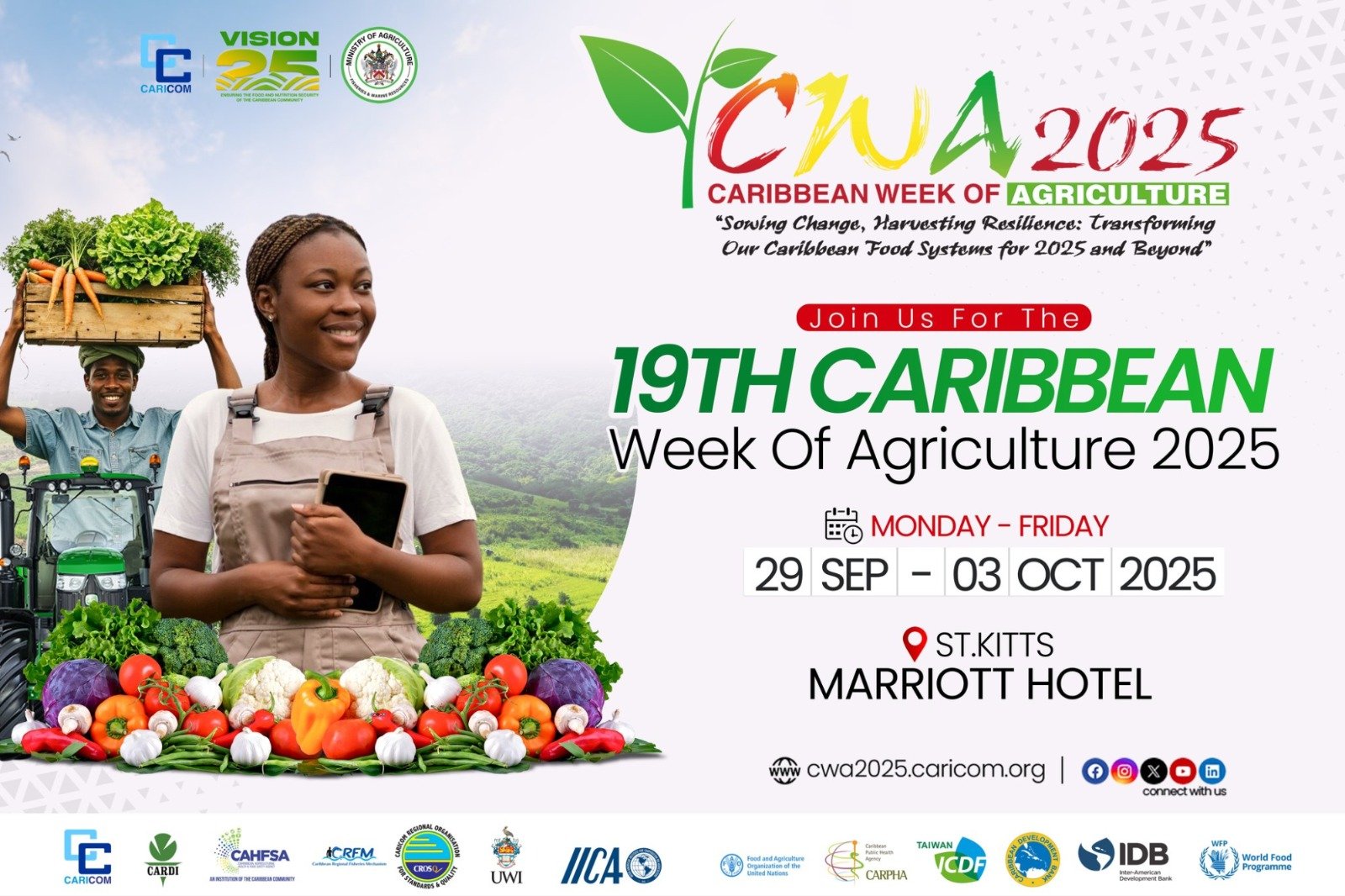
The 19th edition of the Caribbean Week of Agriculture (CWA) officially launched on September 29, 2025, at the St. Kitts Marriott Beach Resort in Frigate Bay, St. Kitts and Nevis. Organized by the Caribbean Community (CARICOM), the annual event brings together policymakers, farmers, researchers, and stakeholders to tackle key issues in agriculture, food security, and sustainable development across the region.
Under the theme “Sowing Change, Harvesting Resilience: Transforming Our Caribbean Food Systems for 2025 and Beyond,” CWA 2025 emphasizes innovation, climate-smart practices, and building resilient agricultural systems capable of withstanding climate and economic pressures.
CARICOM Secretary-General Dr. Carla Barnett, in her opening remarks, highlighted the value of regional collaboration, saying, “The challenges we face in agriculture are multifaceted, but through unity and shared knowledge, we can cultivate a future where our food systems are resilient and sustainable.”
The week-long event includes technical seminars, workshops, and networking sessions focused on sustainable and climate-smart agriculture. A key highlight is the OECS-CARICOM Honey Show (October 1–3), which showcases the role of apiculture in food security, biodiversity, and sustainable livelihoods through demonstrations and judging of honey products.
Additionally, the 30th Agriculture Open Day & Marine Expo (October 2–3) will feature exhibitions from farmers, agri-entrepreneurs, NGOs, and research institutions. Attendees can experience live farm demonstrations, agri-tech showcases, youth-led projects, and local cuisine, alongside cultural performances and evening networking events.
CWA 2025 provides a platform for sharing best practices, forging strategic partnerships, and developing actionable strategies to strengthen Caribbean food systems. Participants are expected to leave equipped with tools to enhance productivity, promote sustainable development, and secure a food-secure future for the region.