Submit News
 About us
 Advertise
 Contact us


 Aug 05, 2026
  4 min read
 Horse racing and tapeball cricket unite in new Guya...
In a landmark convergence of Guyana’s most passionate sporting cultures, horse racing and grassroots cricket have officially joined forces. The organisers of...


09 Aug 2026

In a landmark convergence of Guyana’s most passionate sporting cultures, horse racing and grassroots cricket have officially joined forces. The organisers of...

Any state initiative in the bottled water sector should be structured to strengthen, not compete with or undermine, existing private investment, the...

The family of two-year-old Larissa, who was diagnosed with West syndrome at two months old and experiences up to 100 seizures...

 Go-Invest CEO says Guyana emerges as “Jaguar Economy” with record growth and strategic investments



Guyana has quietly positioned itself as one of the world’s fastest-growing frontier economies, posting a 43% GDP expansion in 2024, marking the fifth consecutive year of double-digit growth, according to Hon. Dr. Peter R. Ramsaroop, Chief Investment Officer and Agency Head of the Guyana Office of Investment.
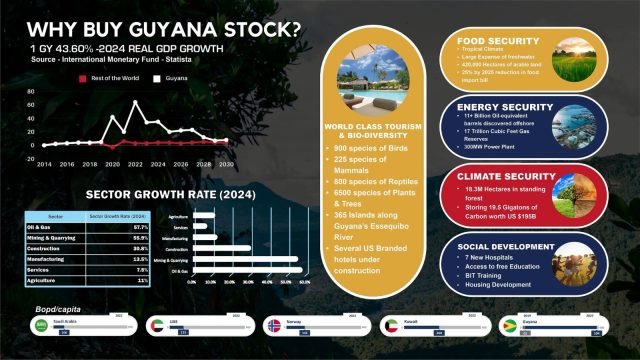
Speaking on the nation’s economic trajectory, in a public statement made on social media, Dr. Ramsaroop highlighted that Guyana’s growth is not solely driven by natural resources but also by disciplined leadership, prudent fiscal policy, and long-term institutional resilience.
The country, along with its regional neighbors Brazil and Suriname, has been dubbed a “Jaguar Economy”, reflecting fast-moving, efficient, and resilient growth fueled by hydrocarbon wealth and diversified investments. “Just as the ‘Tiger Economies’ of Southeast Asia defined a manufacturing-led boom four decades ago, the Jaguar Economies of the Guiana Shield are now charting a distinct model: resource-powered, investment-disciplined, and globally strategic,” Dr. Ramsaroop said.
It was further noted in the statement that under President Dr. Mohamed Irfaan Ali, Guyana has anchored its transformation on fiscal governance and institutional reinvestment. The Natural Resource Fund (NRF), now worth billions, is being directed toward infrastructure, education, energy, climate security, biodiversity, and digital systems rather than short-term consumption.
Dr. Ramsaroop described Guyana as a sovereign portfolio, or “1GY Ticker,” with each sector functioning as an asset class contributing to balanced and resilient growth:
– Oil & Gas: Daily production from the Stabroek Block has surpassed 600,000 barrels and is expected to reach 1.3 million by 2027, with ExxonMobil calling it one of its highest-return assets globally.
– Gas-to-Energy: The $1.3 billion Gas-to-Shore project will provide 300 MW of power, reducing industrial energy costs below US$0.15/kWh, with a further 300 MW planned.
– Renewables: Guyana aims for 70% renewable electricity by 2030, supported by multilateral financing.
– Gold: Nearly $1 billion in export earnings in 2024, providing macroeconomic stability.
– Agriculture: The country achieved self-sufficiency in all seven food groups, with rice exports exceeding $250 million in 2024.
– Carbon Credits: Guyana’s ART-TREES framework allows jurisdictional carbon credits at scale, with institutional commitments from Hess and purchases by Apple.
– ICT & AI Infrastructure: A $1.3 billion ICT Master Plan is modernizing public services and positioning Guyana as a nearshore data and fintech hub.
– Light Manufacturing & EV: The arrival of EV manufacturer BYD in 2025 signals a shift toward green industrialization, supported by deepwater port expansions in Berbice and Demerara.
Dr. Ramsaroop emphasized that Guyana’s food sovereignty and strategic geography extend its advantage to a 400-million-person regional market through modern trade corridors and preferential agreements.
“Guyana’s agricultural self-sufficiency is more than national pride—it’s geopolitical leverage,” he said.