Submit News
 About us
 Advertise
 Contact us


 Aug 05, 2026
  4 min read
 Horse racing and tapeball cricket unite in new Guya...
In a landmark convergence of Guyana’s most passionate sporting cultures, horse racing and grassroots cricket have officially joined forces. The organisers of...


07 Aug 2026

In a landmark convergence of Guyana’s most passionate sporting cultures, horse racing and grassroots cricket have officially joined forces. The organisers of...

Any state initiative in the bottled water sector should be structured to strengthen, not compete with or undermine, existing private investment, the...

The family of two-year-old Larissa, who was diagnosed with West syndrome at two months old and experiences up to 100 seizures...

 Panel highlights evolving role of U.S. Constitution in modern democracy


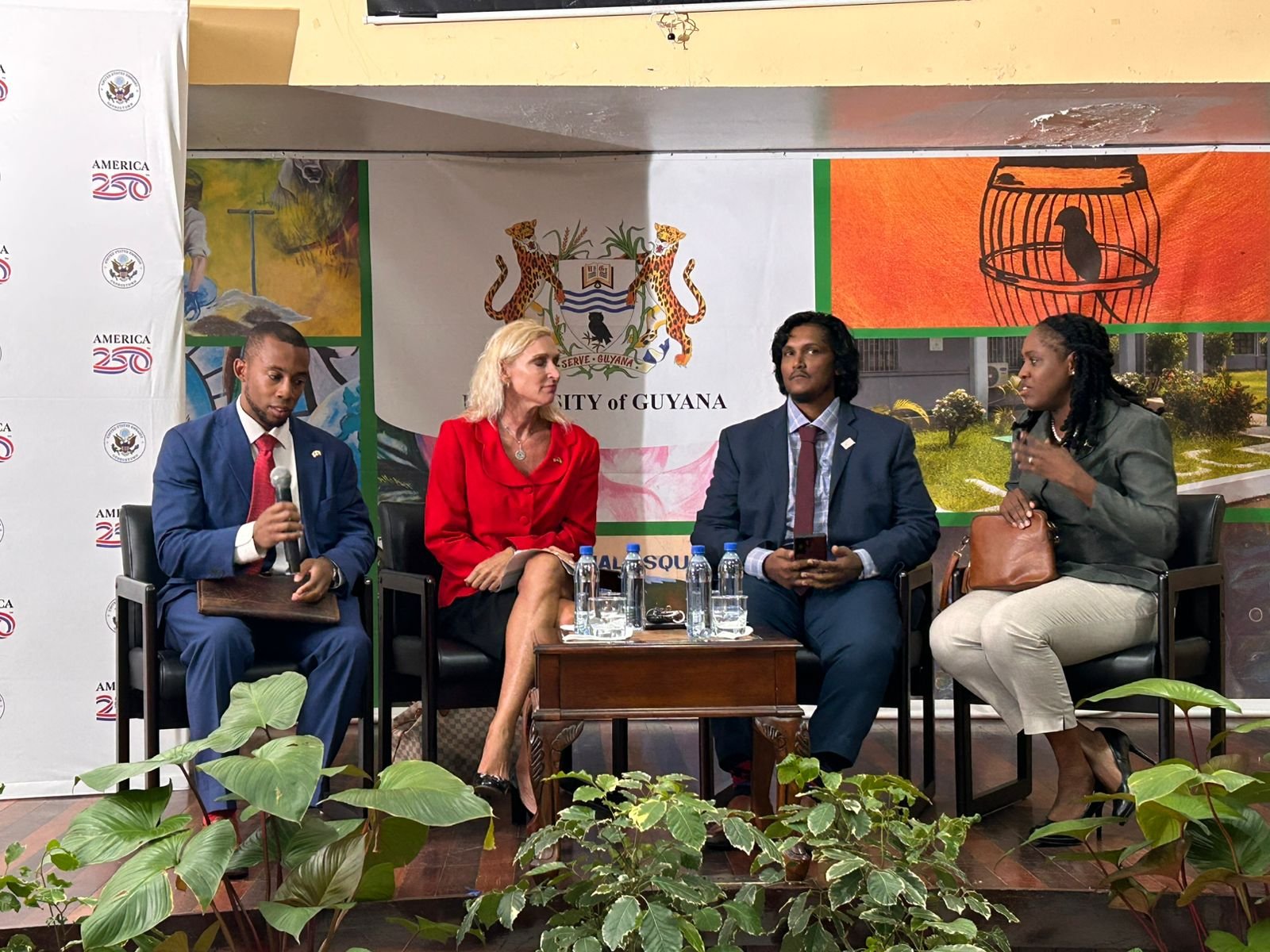
The evolving nature of the U.S. Constitution and its impact on modern democracy was the focus of a panel discussion hosted by the U.S. Embassy in Guyana on Monday evening, part of its Freedom 250 Constitutional Conversations series.
The event at the University of Guyana marked the launch of a year-long initiative commemorating 250 years of American independence and 60 years of diplomatic relations between the United States and Guyana.
Public Affairs Officer Jared Crockett said the series goes beyond celebration, aiming to reflect on America’s diplomatic legacy, strengthen partnerships, and inspire the next generation of leaders.
U.S. Ambassador Nicole D. Theriot described the Constitution as a “living document,” noting that while its core structure remains intact since 1787, it continues to evolve through amendments, judicial interpretation, and legislative action.
She explained that only 27 amendments have been made, underscoring the document’s stability while allowing flexibility to address modern challenges such as civil rights and social change.
Panelists Dr. Deodat Persaud and Sarabo-Halley, both alumni of U.S. exchange programmes, discussed the influence of U.S. governance on democratic practices. Sarabo-Halley highlighted the principle of federalism, noting that stronger legislative scrutiny of national budgets and greater collaboration in governance could benefit Guyana’s democratic framework.
Dr. Persaud emphasised civic education and public engagement, pointing to oversight mechanisms such as congressional hearings that hold the executive accountable.
Both panelists agreed that exchange programmes broaden perspectives, enabling participants to experience governance systems firsthand and adapt best practices at home. The discussion also explored how citizen participation, social movements, and institutional checks and balances continue to shape democratic systems.