Submit News
 About us
 Advertise
 Contact us


 Aug 05, 2026
  4 min read
 Horse racing and tapeball cricket unite in new Guya...
In a landmark convergence of Guyana’s most passionate sporting cultures, horse racing and grassroots cricket have officially joined forces. The organisers of...


09 Aug 2026

In a landmark convergence of Guyana’s most passionate sporting cultures, horse racing and grassroots cricket have officially joined forces. The organisers of...

Any state initiative in the bottled water sector should be structured to strengthen, not compete with or undermine, existing private investment, the...

The family of two-year-old Larissa, who was diagnosed with West syndrome at two months old and experiences up to 100 seizures...

 Brian Sucre Junction residents gain access to water for the first time


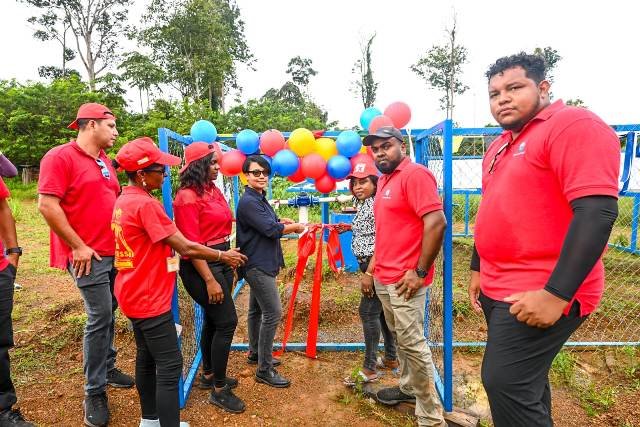
More than 100 residents of Brian Sucre Junction in Region Eight now have reliable, first-time access to clean and dependable water following the commissioning of a new $35 million water supply system.
The system was officially inaugurated on Monday by Minister within the Ministry of Housing and Water, Susan Rodrigues, marking a major milestone in the government’s ongoing efforts to improve public utilities in the hinterland.
The project, executed by Mohamed Excavation & Construction and Q&A Civil Works, involved the drilling of a potable water well, the construction of a solar-powered pumping system, elevated metal trestles, a pipe distribution network, and direct household connections.
Until now, residents of Brian Sucre Junction relied on rainwater harvesting or a nearby spring for their daily water needs—both unreliable and unsustainable sources, particularly during the dry season.
The new system forms part of a broader government strategy to enhance water access across Region Eight. Since 2021, more than $1 billion has been spent on water infrastructure in the region, including the drilling of over 15 new wells. An estimated $440 million was allocated to communities such as Kaibarupai, Monkey Mountain, and Kato.
A further $161 million facilitated new systems in Kamana, Itabac, Micobie, and Sand Hill, while Karisparu alone benefited from upgrades valued at $60 million.
Across the hinterland, more than $5.5 billion has been invested over the past five years to expand water distribution networks. And the momentum continues: over $2 billion is earmarked for 2025 to drill additional wells and extend treated water access even further.
The government has set an ambitious yet clear goal: to achieve 100 per cent access to safe, potable water in hinterland regions by the end of 2025. (DPI)