Submit News
 About us
 Advertise
 Contact us


 Aug 05, 2026
  4 min read
 Horse racing and tapeball cricket unite in new Guya...
In a landmark convergence of Guyana’s most passionate sporting cultures, horse racing and grassroots cricket have officially joined forces. The organisers of...


08 Aug 2026

In a landmark convergence of Guyana’s most passionate sporting cultures, horse racing and grassroots cricket have officially joined forces. The organisers of...

Any state initiative in the bottled water sector should be structured to strengthen, not compete with or undermine, existing private investment, the...

The family of two-year-old Larissa, who was diagnosed with West syndrome at two months old and experiences up to 100 seizures...

 Dragon fruit pilot launched to boost crop diversification, farmer incomes


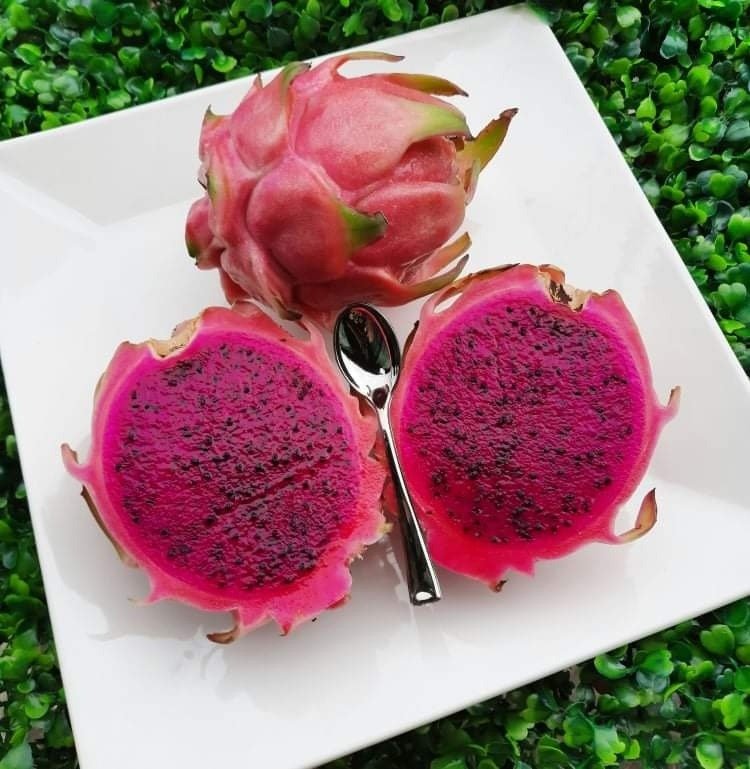
Small-scale farmers in Regions Four and 10 are set to benefit from a new initiative introducing commercial dragon fruit cultivation, aimed at strengthening crop diversification, reclaiming mined-out lands, and boosting income generation.
The project is spearheaded by the Guyana Lands and Surveys Commission (GLSC) and the Food and Agriculture Organisation of the United Nations (FAO), in collaboration with the National Agricultural Research and Extension Institute (NAREI). Financing is provided through the Guyana REDD+ Investment Fund (GRIF) under the Mainstreaming Sustainable Land Development and Management (SLDM) project.
The pilot follows a knowledge exchange mission to Brazil’s Agricultural Research Corporation (EMBRAPA), where Guyanese experts studied soil conservation, agroforestry, and mined-out land reclamation. Dragon fruit, which thrives in nutrient-poor soils, emerged as a promising crop for Guyana’s unique conditions.
“This high-value crop is new to Guyana. With both wet and dry conditions suitable for its cultivation, and with the training, farmers can easily produce dragon fruit. It will increase income and move Guyana from importing to producing — and even exporting,” said Kevin Paul of NAREI.
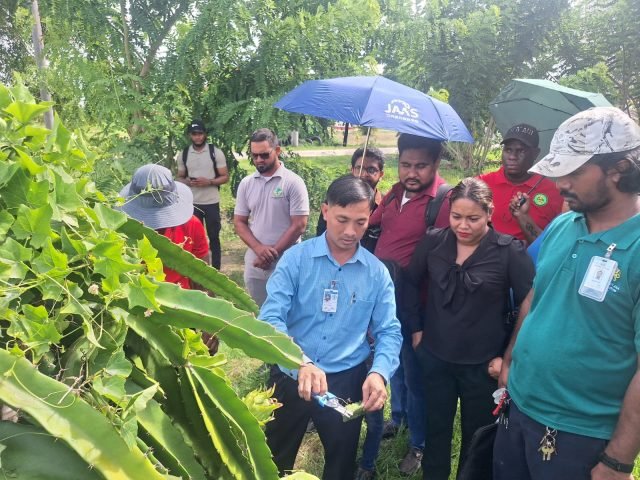
The programme officially began with a Training of Trainers (ToT) session on August 12 at NAREI’s Mangrove Hall, Mon Repos, bringing together 32 participants, including representatives from the University of Guyana’s Faculty of Agriculture and Forestry, the Guyana School of Agriculture, and GLSC. A second session on August 14 at NAREI’s Kairuni Station provided practical training to 37 farmers along the Linden–Soesdyke Highway.
The sessions, facilitated by FAO experts Nguyen Van Son and Md Fazlay Arafat, focused on ecological requirements, trellising systems, pest and disease management, fertiliser use, and post-harvest handling. Farmers also gained hands-on experience in NAREI’s dragon fruit orchard.
Farmer Muhammad Haron praised the initiative, noting: “I enjoyed the way the information was presented. The interaction with the experts was great, and I am looking forward to planting dragon fruit on our farm. I believe it will be successful.”
To support commercial adoption, each participating farmer will receive 200 dragon fruit saplings, 50 prefabricated trellises, and technical support from NAREI’s extension officers. They will also benefit from training manuals, post-harvest guidance, and market linkages.
SLDM Project Manager Ahmed Jan highlighted the project’s wider impact: “Crop diversification is key to stronger food systems and better farmer incomes.”
NAREI Chief Scientist David Fredericks and GLSC Project Officer Asib Mohammed echoed the call for collaboration in building a viable dragon fruit industry, with potential to serve both domestic and export markets.
Beyond income generation, the project is expected to enhance climate resilience by introducing a drought-tolerant fruit while creating new opportunities in nurseries, trellis fabrication, agro-processing, and aggregation. In the short term, the initiative will support import substitution, with strong prospects for future exports.