Submit News
 About us
 Advertise
 Contact us


 Aug 05, 2026
  4 min read
 Horse racing and tapeball cricket unite in new Guya...
In a landmark convergence of Guyana’s most passionate sporting cultures, horse racing and grassroots cricket have officially joined forces. The organisers of...


11 Aug 2026

In a landmark convergence of Guyana’s most passionate sporting cultures, horse racing and grassroots cricket have officially joined forces. The organisers of...

Any state initiative in the bottled water sector should be structured to strengthen, not compete with or undermine, existing private investment, the...

The family of two-year-old Larissa, who was diagnosed with West syndrome at two months old and experiences up to 100 seizures...

 The country with vast rainforests and a new, thriving oil industry


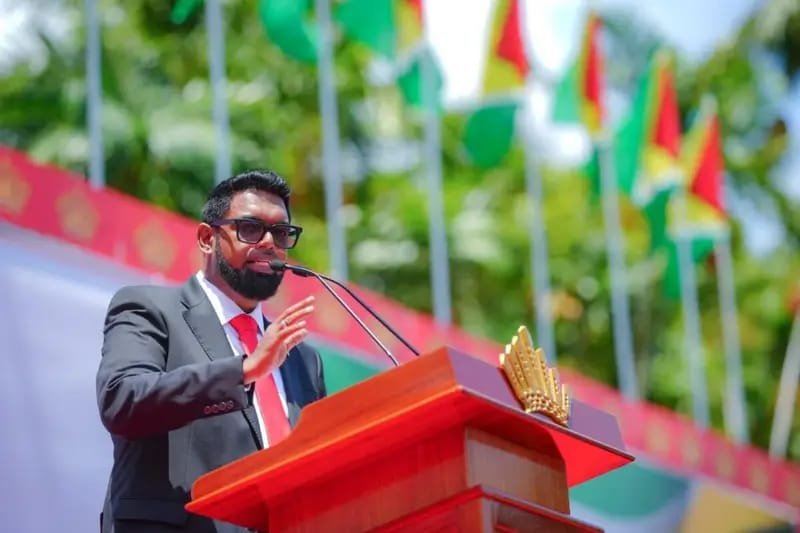
An interview with Mohamed Irfaan Ali, president of Guyana
By David Gelles
Tucked beside Venezuela and Brazil, Guyana is full of lush tropical rainforests and has started innovative programs to protect its biodiversity. It is also an ascendant oil exporter and is set for some extraordinary growth in oil production in the years ahead. President Mohamed Irfaan Ali feels this paradox intensely. Last year, he accused a BBC reporter of “lecturing” him on climate change and railed against the moral “hypocrisy” of Western nations who criticize Guyana while denying financial support for environmental conservation. When we spoke, Ali described how his government is working to defend against sea-level rise and deforestation. At the same time, he spoke proudly of growing revenues from fossil-fuel production and of putting some of those profits into Guyana’s renewable-energy transition.
When you see the U.S. retreat from engagement in climate issues, what does that mean for Guyana?
The withdrawal of the United States from the Paris Agreement is a major blow. We can’t debate that. The U.S. is not only a major emitter of greenhouse gases, but it wields tremendous influence in global affairs. The climate crisis is an existential crisis for many of us. We simply cannot afford to fold our hands and do nothing. We’re working closely with our neighbors, especially Brazil and Suriname, on forest biodiversity and resilience. With the U.S. out of the Paris Agreement, then predictability on financing becomes an issue. It opens up a floodgate for others to also be unpredictable in the policy-making environment. Everything that surrounds climate change, commitment and policy requires global consensus, basically.
Is the global community actually making the financing available so that nations like Guyana can undergo the energy transition?
Absolutely not. It’s ridiculous sometimes to listen to the pledges, because none of the pledges is actualized. When you ask the developing world to adopt measures to limit the impact of whatever we are doing on climate, you’re asking us to transition when we have major issues on energy equality, energy poverty, energy access. And then to complicate issues, these very countries are asked to function in a digital world, so they are already suffering from immense poverty because they were never able to adapt to the Industrial Revolution. Now they are moving into the digital revolution with A.I. that they will never be able to catch up with. And at the same time, basic things like clean water, access to electricity — major segments of the population don’t have this. This is something that has severely impacted the quality and equity of global policy-making. And there is no clear path and no clear plan as to how we are going to address these issues.
‘We can’t be naïve. The world will need fossil fuel a long time into the future.’
I heard implicitly in what you just said that climate change is the ultimate long-term problem in a world that is so often consumed with these short-term crises. I would put it even better: It’s a sacrificial lamb. Climate change is a sacrificial lamb that is always postponed. If you look at the last five years, we have not accelerated momentum. We have really stagnated. We are not implementing what we commit ourselves to do globally.
One thing that has not stagnated is temperature rise. What will this mean for the people of Guyana?
If we did not have the type of revenue stream that we have now, it would have meant debt. It would have meant destruction. It would have meant our economy just falling apart. Guyana is a new oil producer, but we are using the resource to finance our energy transition, to build resilient infrastructure, to support the region that we are in, to invest in livelihood options that will keep our forest standing, which stores many gigatons of carbon. We’re investing in solar farms, hydro, natural gas, wind and biomass, all aimed at transitioning to a low-emission energy grid. We are building off-grid systems, solar farms, wind farms for the hinterland community, where the Indigenous people live.
‘Climate change is a sacrificial lamb.’
You talk about how, for Guyana, the answer to coping with a hotter world is in fact being funded by the production of more fuels that are causing that warming. That of course is sort of the conundrum in a nutshell, right?
I don’t see it as a problem. Your question in the context of Guyana is quite different from your question in the Middle East, or your question in one of the industrial countries. For us, it’s quite different.
How do you see a way out?
We have this standing forest that has been there for all our lives, which the world does not see a value in. It’s easy. If the world says, “We’re going to pay a fair-market rate for the forests that have ecological and biodiversity sources that also have a price,” then it will allow countries like ours that are forested to then use the revenue from that to protect our land, to invest in health, to invest in education, human development and infrastructure, to remain competitive and to build a strong and resilient economy. So the moral question is: Who can produce what the world needs in the least environmentally damaging way? Because let’s be clear on this too. We can’t be naïve. The world will need fossil fuel a long time into the future. (New York Times)