Submit News
 About us
 Advertise
 Contact us


 Aug 05, 2026
  4 min read
 Horse racing and tapeball cricket unite in new Guya...
In a landmark convergence of Guyana’s most passionate sporting cultures, horse racing and grassroots cricket have officially joined forces. The organisers of...


08 Aug 2026

In a landmark convergence of Guyana’s most passionate sporting cultures, horse racing and grassroots cricket have officially joined forces. The organisers of...

Any state initiative in the bottled water sector should be structured to strengthen, not compete with or undermine, existing private investment, the...

The family of two-year-old Larissa, who was diagnosed with West syndrome at two months old and experiences up to 100 seizures...

 Calls made for AI to be more digitally inclusive


With advancements in the use of Artificial Intelligence (AI), calls are being made for it to be more digitally inclusive in support of people of African descent.
Representative of the Association of People of African Descent (APAD), Dr Ruackel Easton, made the call while delivering an address at the high-level session of the fourth meeting of the Permanent Forum on People of African Descent.
The forum, held under the theme “Africa and people of African descent: United for reparatory justice in the age of Artificial Intelligence,” concluded today at the United Nations Headquarters in New York.
In his remarks, Dr Easton stated that people of African descent in the Caribbean and across the globe are still fighting to be fully seen, heard and respected.
He highlighted the need for digital support through AI, particularly in relation to facial recognition and social reform systems. He argued that people of African descent remain structurally disadvantaged, as they are not considered default users.
“Even in the Caribbean, where AI policy is emerging, we are not meaningfully protected. There are no binding safeguards against the extraction of our data, no firm guardrails against digital colonisation. That must change. We’re not asking for inclusion; we’re demanding transformation. We demand the criminalisation of algorithmic discrimination. We demand data sovereignty, and epistemic justice. Afrocentric knowledge, language and values must be recognised and rooted in AI development. We demand global accountability — the UN must lead in establishing a binding framework to regulate AI use in the public sphere and sanction its misuse,” Dr Easton said.
He further urged the UN to take concrete action on the statements made at the forum, with the aim of improving the lives of people of African descent.
“This is not a call for fairness; it’s a declaration of digital justice. We are not passive users of technology — we are builders of the future. And if AI is to shape that future, it must belong to us as well,” he added.
Over the four-day forum, several Guyanese officials delivered remarks.
On Monday, Labour Minister Joseph Hamilton noted that Guyana has made significant progress in advancing the cause of people of African descent and will continue to do so with the use of AI.
Chairman of the Ethnic Relations Commission (ERC), Shaikh Moeenul Hack, also called for inclusive efforts in advancing that cause.
The ERC, in a statement issued on Tuesday, emphasised the importance of collective support in addressing injustices such as reparations and highlighted its ongoing efforts to prioritise African culture and related issues.
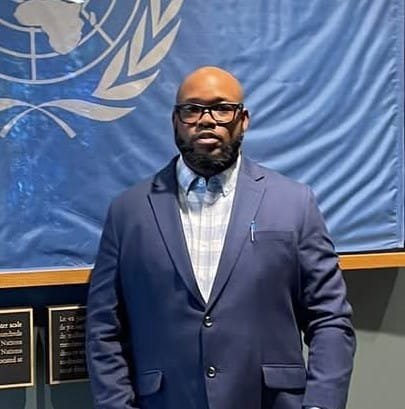
Dr Ruackel Easton