Submit News
 About us
 Advertise
 Contact us


 Aug 05, 2026
  4 min read
 Horse racing and tapeball cricket unite in new Guya...
In a landmark convergence of Guyana’s most passionate sporting cultures, horse racing and grassroots cricket have officially joined forces. The organisers of...


08 Aug 2026

In a landmark convergence of Guyana’s most passionate sporting cultures, horse racing and grassroots cricket have officially joined forces. The organisers of...

Any state initiative in the bottled water sector should be structured to strengthen, not compete with or undermine, existing private investment, the...

The family of two-year-old Larissa, who was diagnosed with West syndrome at two months old and experiences up to 100 seizures...

 US narco report ‘simply speculative’


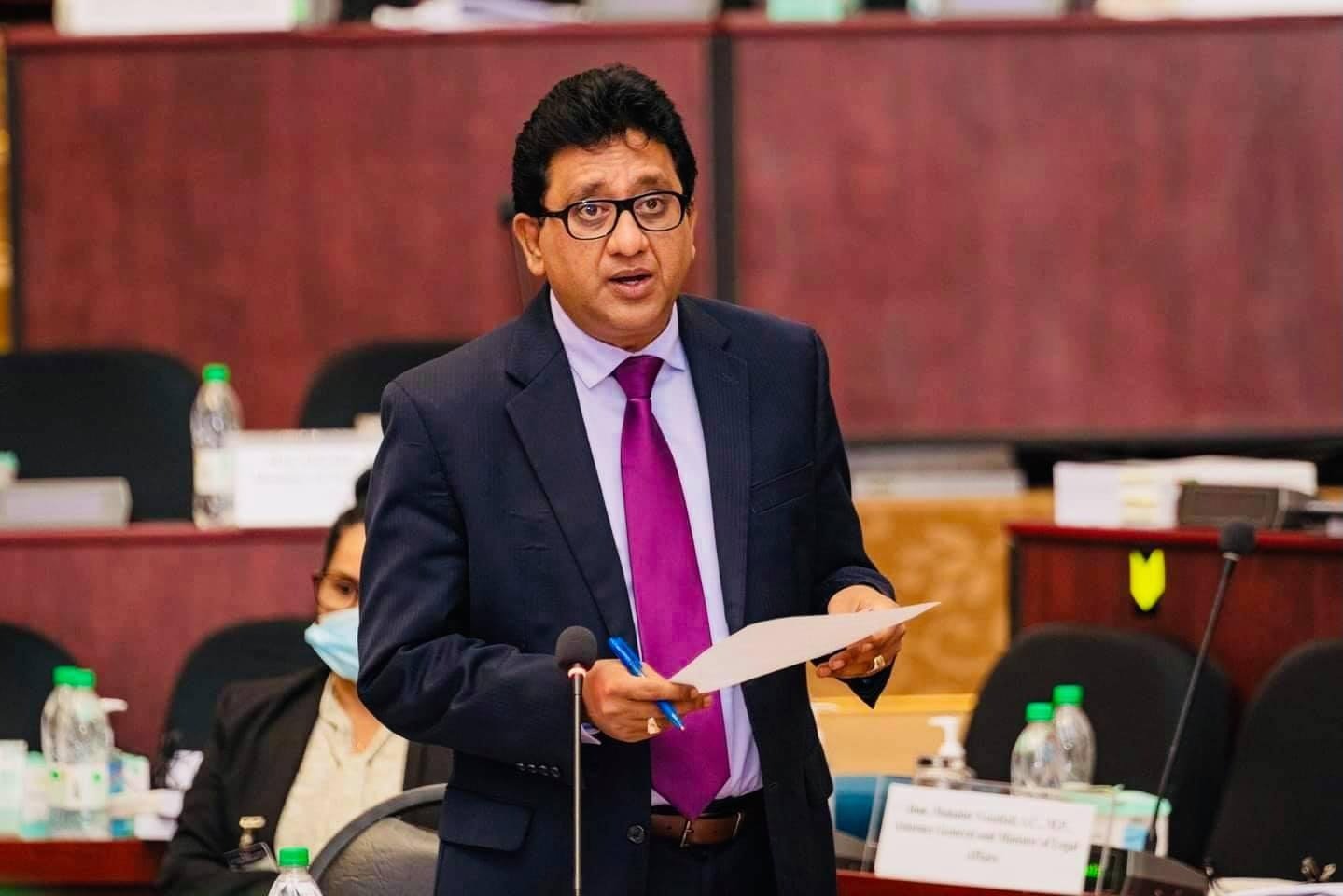
Attorney General and Legal Affairs Minister, Anil Nandlall, has rejected the 2025 International Narcotics Control Strategy Report (INCSR) issued by the US State Department, noting that there must be empirical evidence to substantiate any claims linking money laundering to corruption, organised crime, and holders of public office.
The Attorney General, who also chairs the National Task Force on Anti-Money Laundering/Countering the Financing of Terrorism (AML/CFT), was speaking on his weekly Issues in the News programme when he described the US’s assertions as “simply speculative”.
He emphasised that the Caribbean Financial Action Task Force (CFATF) is the authorised body monitoring and regulating Guyana in matters related to AML/CFT, not the US State Department.
“CFATF is the authorised agency to express opinions and pass judgment on matters of an AML/CFT nature; and with the greatest respect to the State Department, that is not their functional responsibility. In fact, I don’t know what criteria they’re using to make the conclusions that they have made.”
The Attorney General reminded that, over an 18-month period from September 2022 to June 2024, Guyana underwent a mutual evaluation exercise conducted by the most premier regulatory body in this hemisphere—the CFATF. During this process, every aspect of the country’s AML/CFT framework was critically scrutinised, including its legislative framework, administrative processes, investigative capabilities, and law enforcement and prosecutorial capacities.
He said that experts from the CFATF visited Guyana on multiple occasions, spending up to two weeks at a time interviewing individuals across the public sector, as well as in the private sector. Additionally, various critical sectors were examined, including mining, banking, real estate, revenue collection, gaming authorities, and the Commercial and Deeds Registries.
At the end of this rigorous examination, the Attorney General stated that Guyana had to defend its evaluation report at the Plenary and Working Group Meeting before representatives from across the Caribbean and Central America—including the United States, which is now a member of the CFATF and participated in the meeting at the time.
“Guyana’s AML/CFT framework was laid bare and we had to defend the report, and at the end of that process, Guyana came out with excellent evaluations. In fact, Guyana did better than almost every independent Caribbean state in the fourth round mutual evaluation process.”
The country’s ratings, the Attorney General continued, were then submitted to the international AML/CFT body, the Financial Action Task Force (FATF), where they received that agency’s approbation. He explained that once Guyana met the standards of the FATF’s evaluation, the matter was conclusive and no other agency could undermine the achievements made.