Submit News
 About us
 Advertise
 Contact us


 Aug 05, 2026
  4 min read
 Horse racing and tapeball cricket unite in new Guya...
In a landmark convergence of Guyana’s most passionate sporting cultures, horse racing and grassroots cricket have officially joined forces. The organisers of...


08 Aug 2026

In a landmark convergence of Guyana’s most passionate sporting cultures, horse racing and grassroots cricket have officially joined forces. The organisers of...

Any state initiative in the bottled water sector should be structured to strengthen, not compete with or undermine, existing private investment, the...

The family of two-year-old Larissa, who was diagnosed with West syndrome at two months old and experiences up to 100 seizures...

 Kamla returns to power


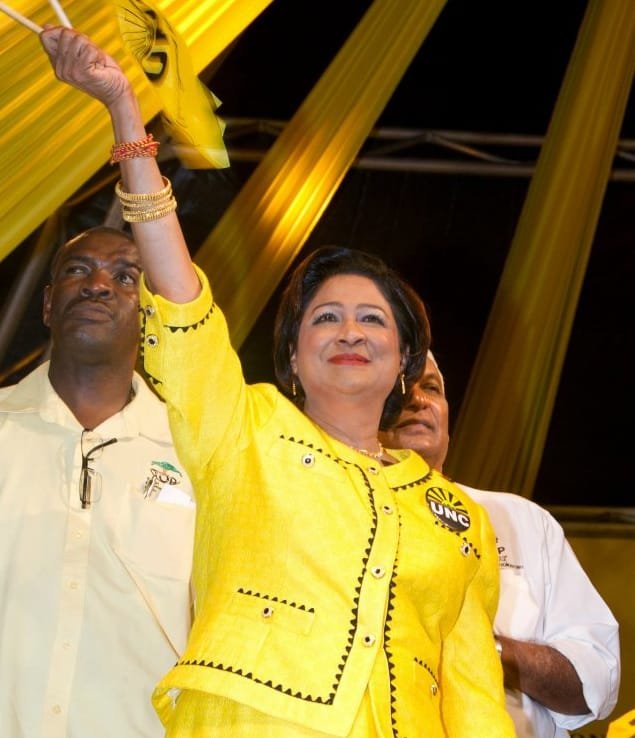
In a stunning political upset that has redrawn the political map of Trinidad and Tobago’s, the United National Congress (UNC), led by Kamla Persad-Bissessar, has swept to victory in the April 28 general election, toppling the People’s National Movement (PNM) from government after a decade in power.
The UNC’s triumph was built on a groundswell of public discontent and a meticulously executed social media and promotional campaign that broke through long-standing political barriers of race, class and geography.
Persad-Bisessar will be prime minister for a second time, and lead into Parliament a group of incumbents, new faces, and several coalition partners.
The result was known before 10 pm.
Persad-Bissessar said to her supporters “From all indications the UNC has won the elections. Do not become boastful and arrogant, we have a lot of work to do. God bless all of you. The marginals are trending ahead, Tunapuna, St Joseph…”
And it was retiring Dr Keith Rowley, and not Prime Minister Stuart Young, who took the podium at Baliser House, Port of Spain to deliver the news to a devastation group of supporters.
He said the population had chosen a “package of promises”.
Political analysts saw this result coming weeks ago.
Across the country’s fiercely contested marginal constituencies, including San Fernando West, St. Joseph, Tunapuna, and even the once-safe Toco/Sangre Grande, voters sent a clear and unmistakable message, they wanted change, instead of the new chapter that was promised by Stuart Young, whose stint will be just four months as prime minister.
The 2020 general election had left the PNM, under Dr. Keith Rowley, clinging to power by narrow margins, even as signs of voter fatigue began to show.
In this general election cycle, the political landscape was almost unrecognisable. Rowley, who had announced he would not seek re-election as Prime Minister but still led the PNM into the campaign, faced an electorate upset by the government’s handling of the Covid-19 pandemic, and worn down by economic hardship, spiraling crime, and accusations of governmental complacency and arrogance.
The UNC, despite its political leader being challenged from within by dissident MPs, and from from the outside by discarded former UNC political insiders, capitalised on the national mood with a message of reform, accountability, and renewal. Their aggressive ground game and polished social media strategy resonated not just with traditional supporters but with disaffected swing voters in urban, suburban, and rural seats alike. The campaign song was infectious, its colour coding engaging, and its campaign meetings were like fetes.
But it was not a two-party race alone. The freshly minted National Transformation Alliance (NTA) spearheaded by former police commissioner Gary Griffith, and the Patriotic Front, led by Mikela panday, the daughter of legendary politician Basdeo Panday also fielded candidates in many of the 41 constituencies, injecting the campaign with new voices and alternative visions.
Despite their spirited challenges, the status quo that is Trinidad two-party system, PNM vs UNC, did not change.
It was the marginals, as always, that told the real story. San Fernando West, which the PNM had narrowly held in 2020, slipped away after a fierce contest that saw the UNC capitalise on local anger over infrastructure neglect. In St. Joseph and Tunapuna, historically seen as bellwethers of national sentiment, voters decisively swung toward the opposition. Even in Toco/Sangre Grande, once a symbol of PNM dominance, a stunning reversal unfolded, with high turnout from traditionally neglected communities tipping the balance.
In the 2020 Trinidad and Tobago general election, the Dr Keith Rowley-led PNM won 22 seats, and the Persad-Bissessar-led UNC won 19 seats. This result allowed the PNM to retain government with a narrow majority in the 41-seat House of Representatives. It was a closer race compared to previous years, with the UNC winning the popular vote in some constituencies but failing to translate those votes into more seats. Several marginal constituencies were crucial to the PNM’s victory, including San Fernando West, Tunapuna, and St. Joseph. Voter turnout was about 58 percent, lower than in past general elections. Minor parties like the Progressive Empowerment Party (PEP) and the Movement for Social Justice (MSJ) also contested, but none won seats. Gary Griffith was not yet a political leader then. He was Commissioner of Police at the time. (Trinidad Express)